
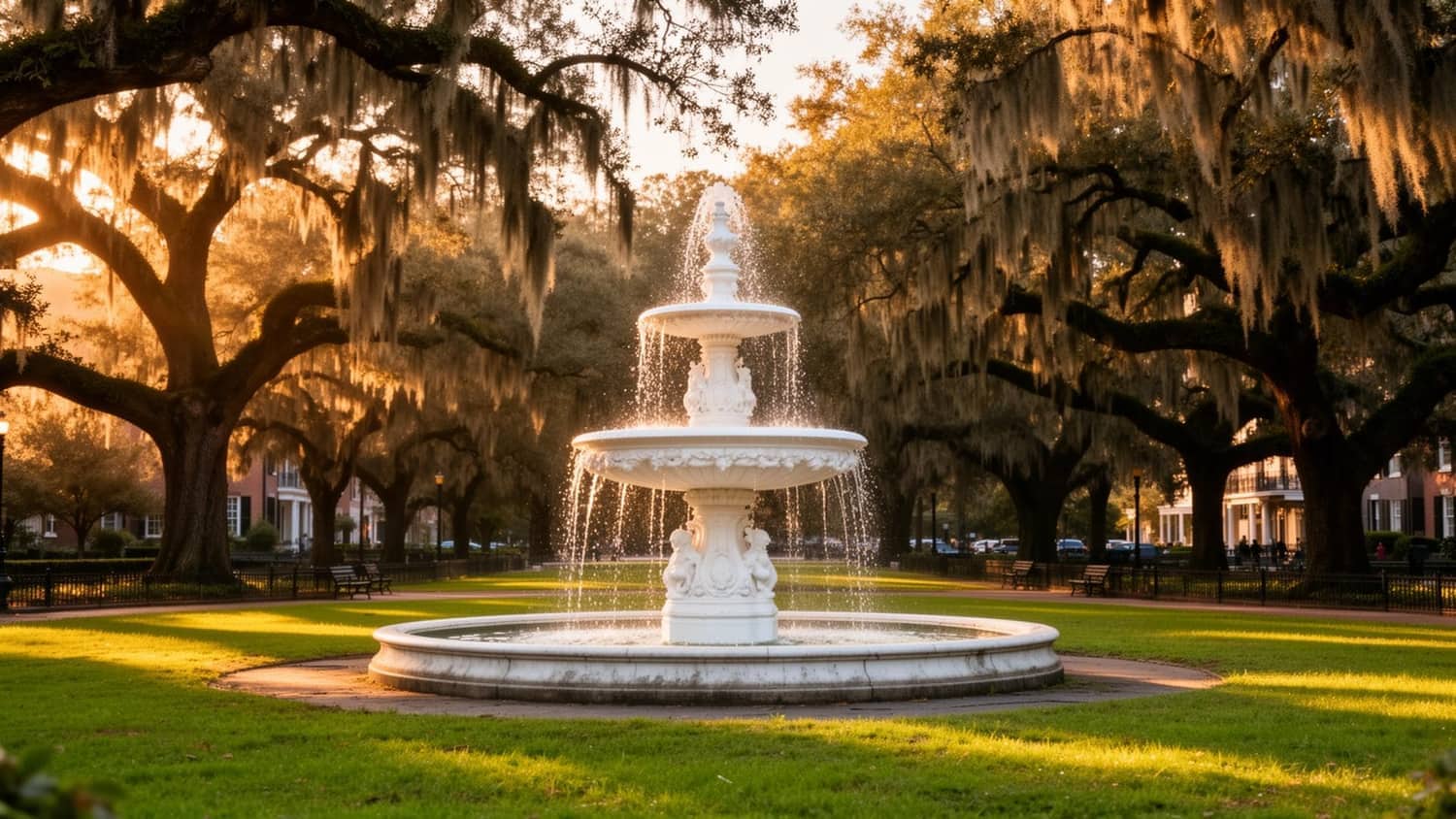
The historic white cast-iron Forsyth Park fountain with water cascading from its upper tiers
Savannah History

Forsyth Park History

From an 1840s city plan to one of the South's most beloved urban parks — the story behind the fountain, the monuments, and the 'dummy fort'.

Book a Savannah tour

In short

Forsyth Park history begins in the 1840s when Savannah set aside land for a public green named after Georgia Governor and U.S. Secretary of State John Forsyth. The park was expanded southward later in the 19th century, its iconic cast-iron fountain was added in 1858, and a non-functional earthwork known as the 'dummy fort' served as a militia training ground.

Origins in the 1840s city plan

Forsyth Park traces its origins to the 1840s, when Savannah's civic leaders set aside a large tract of land at the southern edge of the city's expanding grid as a public green space. The park was named in honor of John Forsyth — a Georgia governor and U.S. Secretary of State who had served in some of the most consequential diplomatic roles of the early American republic. Laying out the park was part of a broader ambition to give Savannah a grand civic centerpiece to match its reputation as one of the most beautiful cities on the Eastern Seaboard. The surrounding neighborhood of elegant town homes and shaded streets grew up around the park over the following decades, and the two have been inseparable ever since.
Sponsored · GetYourGuide
🎟️ Compare Savannah trolley & bus passes
View

The 1858 fountain: a catalog order that became an icon

The most recognizable feature of Forsyth Park was not custom-designed for Savannah — it was selected from an industrial catalog. In 1858, the city ordered a cast-iron fountain from the Janes, Beebe & Co. foundry in New York, one of the leading manufacturers of decorative ironwork in 19th-century America. Similar fountains from the same catalog were installed in other American cities and even internationally, though none have achieved quite the same cultural status as Savannah's. The fountain features a central column with tiered basins, female figures, and swans — all in painted cast iron — and has become the single most photographed object in the city. It was declared a local landmark and has been carefully maintained and restored over the years.
Sponsored · GetYourGuide
👻 Tonight's top-rated ghost tours
View

The southern expansion and the 'dummy fort'

Forsyth Park was extended southward later in the 19th century, adding what became known as the southern extension and roughly doubling the park's total area to around 30 acres. This new southern section served practical civic purposes: it included a military parade ground used by local militia units for drills and exercises. At the south end of this extension stood a non-functional earthwork structure known locally as the "dummy fort" — sometimes recorded as Fort Mercer — a modest earthen fortification built purely as a training prop rather than for any real defensive purpose. It was never involved in any military action. The structure has since been absorbed by the park's development, and the area near the south end where the café and playground now stand occupies roughly the same ground.
Sponsored · GetYourGuide
🚤 Riverboat cruises with free cancellation
View

Monuments, civic life, and Savannah's living park

Over the course of the late 19th and early 20th centuries, Forsyth Park accumulated several monuments that reflect the complex history of the region. A Confederate memorial stands in the park, as does a marker honoring veterans of the Spanish-American War — both testaments to the park's role as a space for public commemoration. Through the 20th century and into the present, the park has been the stage for some of Savannah's most celebrated civic traditions: St. Patrick's Day festivities (when the fountain is famously dyed green), the Saturday farmers market, outdoor concerts, and the daily rhythm of dog walkers, students, and families from the surrounding Victorian District. Today Forsyth Park functions as the living room of Savannah's Historic District — as much a part of the city's character as its cobblestone streets and antebellum architecture.
Recommended tours

Book your Savannah experience

Live availability, real traveler reviews and instant confirmation — most tours offer free cancellation up to 24 hours before.

Powered by GetYourGuide

Tours powered by GetYourGuide. We may earn a commission — it never costs you more.

FAQ

Frequently asked

When was Forsyth Park built?

Forsyth Park was laid out in the 1840s as part of Savannah's expanding city plan, making it one of the older public parks in the American South. The park was later extended southward later in the 19th century, nearly doubling its footprint and adding space for a military parade ground.

Who is Forsyth Park named after?

The park is named after John Forsyth, a notable Georgia statesman who served as Governor of Georgia and as U.S. Secretary of State under Presidents Andrew Jackson and Martin Van Buren. Forsyth had deep ties to Georgia's political life in the early 19th century.

How old is the Forsyth Park fountain?

The iconic cast-iron fountain was installed in 1858, making it over 165 years old. It was ordered from an industrial catalog — the Janes, Beebe & Co. foundry in New York — and similar fountains were installed in other cities, though none have become quite as famous as Savannah's.

Is there a fort in Forsyth Park?

Not an active one — but the southern extension of the park once contained a non-functional earthwork structure known locally as the 'dummy fort' (sometimes called Fort Mercer), built as a drill and training ground for local militia. It was never intended for real defense and is now largely gone, though the café area near the south end occupies roughly that part of the park.

Location

Where is Forsyth Park?

Forsyth Park is a 30-acre public park at the south end of Savannah's Historic District in Georgia, bordered by Drayton Street, Whitaker Street, West Gaston Street and Park Avenue — about one mile south of River Street. It's free and open daily from sunrise to 10 PM.

Address
Forsyth Park, Drayton St & W Gaston St
Savannah, GA 31401
Hours
Daily · sunrise–10 PM
Entry
Free · no tickets
Coordinates
32.0686° N, 81.0951° W
Good to know
South end of the Historic District · ~1 mile (20-min walk) from River Street · street parking on the surrounding squares.

Make the most of your visit

Skip the planning — browse hand-picked tours of Forsyth Park and the Historic District.

See all Savannah tours →